




I. Introduction
Raman Spectroscopy is widely used in chemical analysis in complementary to infrared spectroscopy. By measuring the unique optical emissions called Raman stokes wave Raman spectroscopy is a powerful tool to investigate various organic and inorganic materials. It can obtain spectra of substances in aqueous solutions and information about symmetric molecular vibrations as well, where infrared spectroscopy usually fails. The typical spontaneous Raman scattering cross sections are in the order of 10 -30cm2 . To achieve error free measurements of such a weak interaction requires optimized detection, excitation source and signal collection schemes.
II. Technical Description
Schematic of the proposed Raman spectroscopy is shown in Figure 1. We have constructed the setup with both the 90-degree and 180-degree collecting schemes. The spectroscopy consists of three sub-systems: stable and high power fiber laser source, fiber optic probe and holographic grating/CCD array based optical spectrometer.

Figure 1. Schematic of the proposed Raman spectrometer (a) 180-degree collection (b) 90-degree collection
II.a. Fiber Laser Source
One of the key components of the proposed system is a compact stable fiber laser. It is capable of delivering infrared output at 1064 nm continuous-wave (CW) output power in excess of tens of watts, with wall-plug efficiency in excess of 20%. It is used to pump a periodically poled Lithium Niobate (PPLN) nonlinear crystal to produce visible green beam at 532 nm. For efficient SHG, the fundamental beam from the fiber laser must be phase-matched to the generated green beam. We have calculated that this condition is satisfied with a PPLN grating period of 6.5 µm. The phase-matching is fine-tuned by varying the crystal oven temperature, with maximum efficiency occurring at an oven temperature in the vicinity of 196°C. We have achieved a conversion efficiency of the SHG process of approximately 4%/W for CW. For various incident pump powers of the CW beam from the Yb-doped fiber laser, the spectra of corresponding SHG green beams have been measured and shown in Figure 2. The spectral widths of the SHG beams are approximately 0.25 nm .

Figure 2. Spectral intensity of SHG green beams with the different incident pump powers from the Yb-doped fiber laser
II.b. Fiber Optic Probe
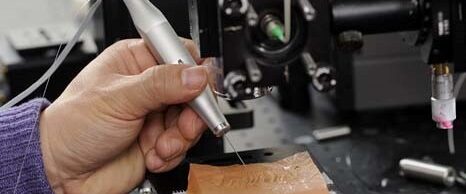
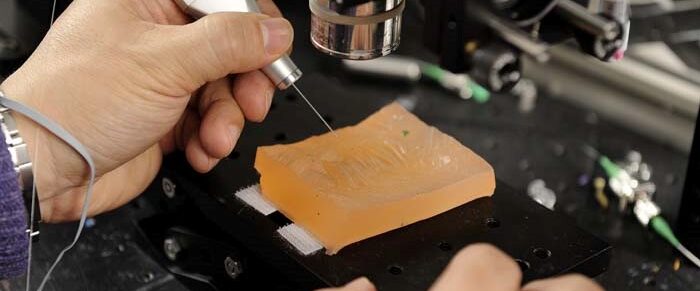
The system uses a highly flexible and durable fiber optic remote probe to both excite the sample and to collect Raman signals. The fiber optic probe is connected to the mainframe (Figure 1) via reinforced multi-layered optical fiber. The optical fiber is a multi-mode fiber which insures highly efficient coupling of the light beams. The probe tip is cased in a stainless steel casing with a Quartz window to insure that it can withstand a large amount of external forces. Inside the probe metal casing, a glass ferrule holds in place the connecting optical fiber, a beam-expanding lens and focusing lens. The visible green light is collimated and the beam is expanded by the beam expander to approximately 4 mm in diameter and subsequently focused onto the sample by the focusing lens. The focused beam on the sample generates spontaneous Raman emission. The Raman signal gets collected by the same focusing lens and the beam expander works in reverse to couple the Raman signal beam efficiently into the connecting optical fiber back to the mainframe. Inside the mainframe a dichroic mirror directs only the Raman signal to the detection module. Additional long wavelength pass filter is used to block the pump beam.
II.c. Raman Detection Module
The Raman detection module is a compact grating based spectrometer designed by Ocean Optics. A schematic of the Raman detection module is shown in Figure 3.

Figure 3. Schematic of the Raman detection module (OceanOptics USB2000)
The detection module allows variable integration time from few milliseconds to tens of seconds and achieves sensitivity about 100 photons/count. The effective wavelength range was from 200 to 860 nm. The CCD array output is read and recorded by a PC via USB connection at a speed of 40 frames/sec.
III. Performance test
The samples used to test our system were solutions of acetone and water mixed in different mole ratios. The measured Raman spectra are shown in Figure 4. The integration time for each sample was 20s. Thanks to the very stable laser center wavelength and power output, this system can easily distinguish these solutions. Spectra from pure water and pure acetone liquids stay at the two extremes, while mixtures with more water would have Raman spectrum closer to pure water than those from the mixtures with more acetone. If we make a lookup table we could determine the approximate proportion of the ingredients in the mixture solutions by measuring their Raman spectra.

Figure 4. Raman spectra measured by the proto-type system |